
Improving the Patient Experience with External Bone Fixators
Not every innovation starts with a complex clinical system. Sometimes the most meaningful problems are hiding in plain sight. This Palmetto Biomedical invention addresses a practical but often overlooked challenge: how patients live, move, dress, sleep, and heal while wearing an external fixation frame secured by pins or wires that pass through the skin.
Functional. But Not Finished.
External fixation devices are workhorses of orthopaedic trauma care. Used to stabilize fractures, dislocations, post-surgical realignments, and joint fusions, they attach to the skeletal structure through the skin and extend outside the body — holding bones in proper alignment while healing occurs over weeks or months.
They do their job well. But they are bulky, visually prominent, and exposed. For patients — often already managing pain, limited mobility, and significant disruption to daily life — the external fixator becomes a constant visible reminder of their injury. There was no practical, cosmetic, and convenient solution for protecting the device or improving its appearance during the healing period.
A Simple, Practical Solution to a Real Patient Problem
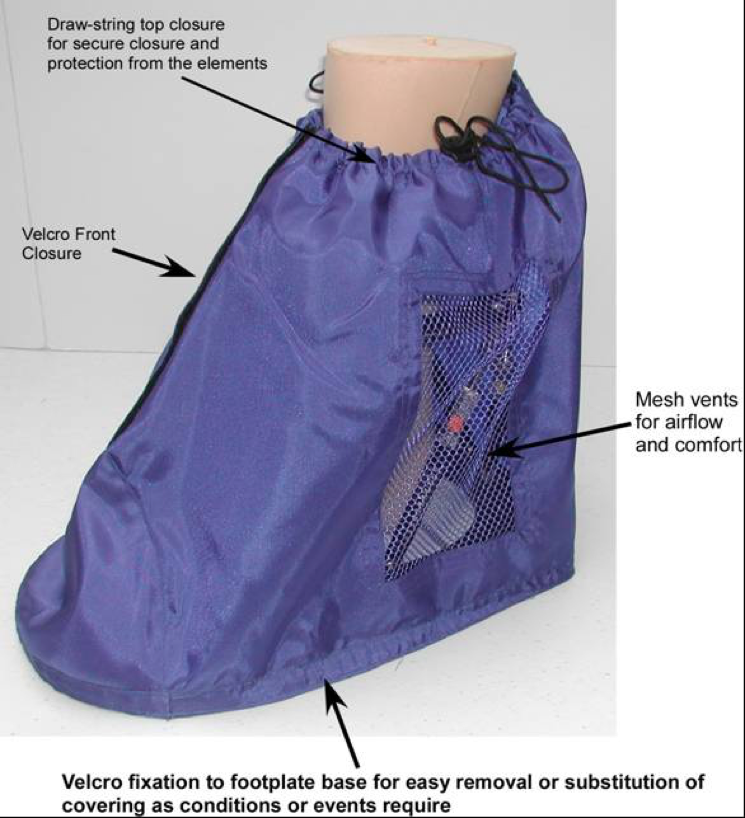
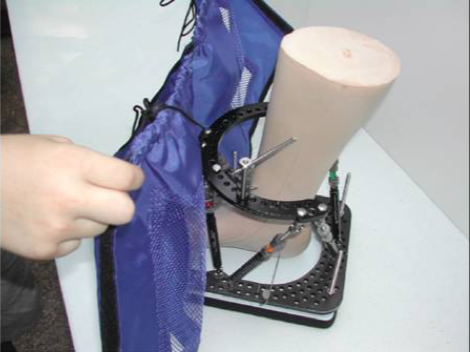
The invention developed through Palmetto Biomedical, with the partnership of an orthopaedic surgeon and an orthotist, addresses this gap directly: a removable protective and cosmetic covering designed to fit securely around an external fixation device on either the upper or lower extremity.
The covering is sized and configured to accommodate varying fixator sizes, using readily engageable and releasable fasteners to secure it around the patient's limb without tools or clinical assistance. Drawstring closures at the open ends allow the covering to be tightened and adjusted to fit comfortably. Ventilation features — including vents with optional airflow components — address the practical challenge of heat and moisture management during extended wear.
For lower extremity applications, the covering includes a configuration designed to attach to a foot plate that can also be adapted to support components of the fixation device itself — extending the utility of the covering beyond aesthetics into functional support.
The result is a practical, patient-centered accessory that protects the device, improves the appearance of the limb during healing, and addresses a quality-of-life gap that had simply gone unsolved.
Issued U.S. Patent
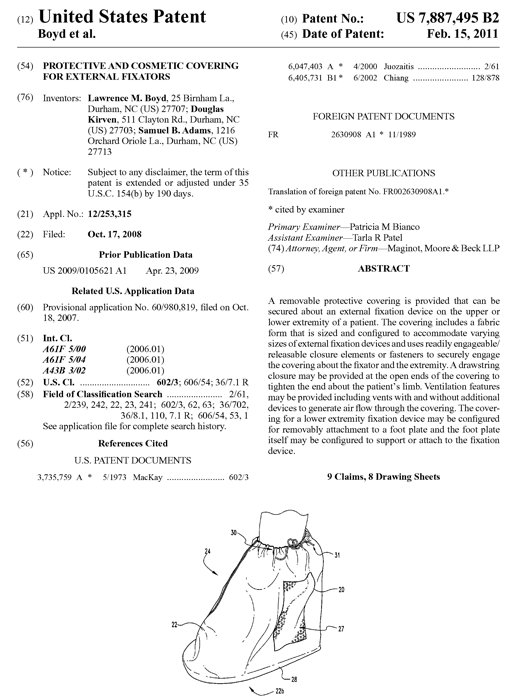
The invention is protected by U.S. Patent 7,887,495 — Protective and Cosmetic Covering for External Fixators — issued February 2011. The patent was the first developed through Palmetto Biomedical Design & Consulting and reflects Dr. Boyd's approach to innovation: identifying problems that matter to patients, collaborating with clinicians, and protecting the solutions that address these unmet needs.
Seeing the Patient, Not Just the Procedure
This invention is a good example of the breadth of Dr. Boyd's innovation and collaborative thinking. It didn't require a new biomaterial, a novel implant design, or a complex delivery mechanism. It required listening to clinicians and paying attention to what patients actually experience during recovery — and recognizing that no one had built a practical solution for it.
That kind of observation is as much a part of medical device innovation as bench science and engineering analysis. Identifying unmet needs, protecting the solutions, and knowing which problems are worth solving is a skill built over decades of working closely with surgeons, patients, and development teams across the full arc of a device's life.
